
Get Paid To Wait
“What are you doing to protect my portfolio if markets pull back?”
It is one of the questions we get the most lately, and it is a good one. This holding is part of our answer.
Most income investments ask you to accept more risk in exchange for more yield. Dynamic Premium Yield PLUS Fund is built the other way around. It aims to deliver a high, steady monthly income while taking on far less stock market risk than owning shares directly. That combination is why it is one of the largest holdings in both our Growth and Income mandates.
How it works, in plain English
Imagine you like a house listed at $500,000, but you would happily buy it at $400,000. Now imagine the seller pays you a fee just to keep your $400,000 offer on the table for a few weeks. If the price never falls that far, you keep the fee and do it again. If it does, you buy a house you wanted anyway, at a price you were happy with.
That is essentially what this fund does with high-quality companies like Microsoft, Walmart and JPMorgan. The managers sell “put options,” which are agreements to buy a stock at a set price well below where it trades today. They collect a payment, called a premium, for making that promise, and keep cash set aside to back those commitments. This version writes somewhat more of them than a fully cash-backed fund would, which boosts the income, and offsets that with extra portfolio insurance. Those premiums are the main source of your income.
A real example from the fund
$182.50
Nvidia’s share price when the trade was placed
$145
The price the fund agreed to buy at, about 21% lower
$1.85
Premium collected per share for a 42-day commitment
~11%
That premium on an annualized basis, versus a dividend yield near zero
Three layers of protection
1. A built-in cushion
Options are typically written 7% to 12% below today’s price. Stocks can fall meaningfully before the fund is affected at all.
2. Portfolio insurance
Part of the income is spent every year buying protection on the broad S&P 500, which pays off in a deeper sell-off.
3. Limited market exposure
The fund moves roughly 58 cents for every dollar the market moves (a beta of 0.58), by design.
Importantly, the managers do not try to predict when a correction will come. The protection is always on, paid for out of the income the strategy earns.
Illustrative example only and not a recommendation to buy or sell any security. Holdings are subject to change. Source: Dynamic Funds, 1832 Asset Management L.P.
Why it matters more right now
Markets have been strong, but that strength has come largely from a narrow group of AI related companies at elevated valuations, with possible rate hikes and pressure on consumer spending in the background. The fund’s managers share that caution and have cut direct stock ownership to about 20%, below its historical average. If an AI pullback or broader sell-off arrives, the strategy is positioned to benefit in a way most investments are not:
- Volatility raises income. When markets get nervous, investors pay more for protection, so the premiums the fund collects get richer.
- Lower prices create opportunity. A falling market lets the fund buy great companies at the discounted prices it set in advance.
- The insurance kicks in. The index protection it carries is designed for exactly this kind of decline.
Volatility is not the enemy of this strategy. In many ways, it is the fuel.
By the numbers
~11%
Annual distribution target, paid monthly
0.58
Beta, or sensitivity to the S&P 500
~47%
Downside capture in market declines
12.2%
Annualized return since 2018 inception
How it held up in major sell-offs
Approximate decline during each drawdown
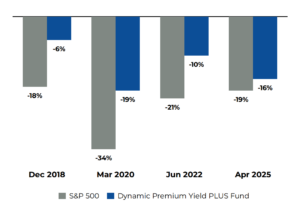
In every market decline greater than 2.5% since the fund launched in 2018, the S&P 500 fell about 6.5% on average. The fund fell about 3.0%, less than half the damage.
The income has been just as consistent. A hypothetical $1 million invested at launch would have paid out about $820,000 in cash distributions, while the account itself was still worth about $1.08 million at the end of August 2026.
What to expect. This is a strategy built for steady income and smaller drawdowns, not for keeping pace with every market rally. In a strong year for stocks it will trail the index; over the past 12 months it returned 16.8% versus 20.4% for the S&P 500. We see that as a fair trade for an investment that has historically held up far better when markets turn negative, and that keeps paying you while it waits.
Its role in your portfolio
So, what are we doing to protect your portfolio? Rather than trying to time the market with a retreat to cash, we have incorporated a strategy with protection built into its design as one of our largest positions. It anchors your portfolio with steady monthly income that depends less on markets continuing to rise. We are always happy to talk it through.
Performance data for Series F as of August 31, 2026, net of fees, in Canadian dollars; S&P 500 returns in USD. Annualized returns: 1 year 16.8%, 3 year 13.3%, 5 year 13.6%, since inception (October 9, 2018) 12.2%. Downside capture and drawdown figures reflect monthly declines in the S&P 500 greater than 2.5% from inception to August 31, 2026; individual drawdown figures are approximate. Hypothetical $1 million illustration assumes a starting investment of 100,000 Series F units in October 2018, no additional purchases or redemptions, distributions paid in cash, and excludes transaction costs and taxes; it is for illustrative purposes only. Distributions are not guaranteed, may consist of net income, dividends, net realized capital gains and/or return of capital, and should not be confused with a fund’s performance or rate of return. Commissions, trailing commissions, management fees and expenses may be associated with mutual fund investments. Dynamic Premium Yield PLUS Fund is an alternative mutual fund and may use leverage, primarily through written put options, with gross derivatives exposure of up to 150% as permitted by its prospectus. Please read the prospectus before investing. Mutual funds are not guaranteed, their values change frequently and past performance may not be repeated. Indices are unmanaged and cannot be invested in directly. Sources: Dynamic Funds, Bloomberg, Morningstar Direct. This document is for information purposes only and does not constitute individual investment advice. Access Family Office Corp.
For informational purposes only. Not intended as tax, legal, or financial advice. Consult a qualified professional for advice specific to your situation.